Duplicate Pages, Canonicals and Redirects: SEO Mistakes Law Firms Should Check
Duplicate pages, incorrect canonicals and redirect errors can cause law firm URLs to compete, be ignored or send users to the wrong destination; SEO-for-Lawyers.com.au checks URL signals, indexability, internal links and redirect paths to identify and fix these issues. Our team connects these technical findings with the practice area pages and enquiry paths that potential clients use.
Why Duplicate URLs, Canonicals and Redirects Matter for Law Firm SEO
Law firm websites need clear URL signals because search engines must determine which page to crawl, index, rank and show to potential clients.
Duplicate content can appear when similar legal service pages target the same search intent. A canonical URL identifies the preferred version of a page, while an HTTP redirect sends users and crawlers to another URL. Google Search may treat these signals differently when they conflict.
A law firm website can lose organic visibility when duplicate URLs divide relevance, canonical tags point to the wrong page or redirects interrupt the route to a useful service page. These problems can also affect index coverage and the conversion path from a search result to an enquiry.
Seven Technical SEO Mistakes Law Firms Should Check
A technical SEO audit should test every important URL and the signals connected to it. We check whether crawling, indexing, internal linking and URL management support the law firm’s intended site architecture.
The following mistakes commonly create competing pages, unclear preferred URLs or broken paths to legal information.
Publishing Near-Identical Practice Area Pages
Near-identical practice area pages are pages with very similar wording, services and search intent. They often arise when a law firm creates separate pages for closely related legal services without giving each page a distinct purpose.
This form of duplicate content can make it harder for Google Search to select the strongest legal service page. We compare the page topics, user intent, headings, internal links and useful information.
Our fix may involve combining overlapping pages, improving their unique value or changing the targeting so each page serves a clear audience. We then review internal links and the relevant canonical signal.
Allowing Multiple URL Versions to Resolve
Multiple URL versions occur when URL parameters, HTTP protocol versions, a WWW subdomain or trailing slash variations all resolve as separate pages.
These versions can split crawling signals and create uncertainty about the preferred URL. URL normalisation gives search engines and users a consistent path to the intended page.
We identify the versions that resolve, select the correct URL structure and align redirects, canonicals, internal links and sitemap entries with that structure.
Using the Wrong Canonical URL
A wrong canonical URL tells search engines that another page is the preferred URL when the visible page should stand on its own.
A rel canonical attribute is an indexing signal, not a command that fixes every duplicate page. Errors happen when templates point to a home page, an old legal service page or a different page with a different search intent.
We check each canonical tag against the page content, preferred URL, internal links and XML sitemap entry. We then correct the canonical implementation so the signal supports the page the firm wants indexed.
Pointing Canonicals to Redirected or Non-Indexable Pages
A canonical target should be a crawlable, indexable page that represents the content of the source URL.
A canonical tag that points through a redirect chain or to a page with a noindex directive creates conflicting instructions. The target may also fail to match the source page’s search intent.
We trace the canonical target, inspect its HTTP response and check crawlability. Our technical remediation points the canonical to the appropriate final page and removes conflicting signals where required.
Redirecting Deleted Legal Pages to Irrelevant Destinations
A deleted page should redirect to a closely related page only when the redirect target serves the same user need.
An irrelevant 301 redirect can confuse visitors and weaken topical relevance. A genuine 404 error or 410 status may be more appropriate when no useful replacement exists.
We review the old page, its backlinks, its role in the site architecture and the likely user expectation. Our redirect mapping sends suitable pages to relevant destinations and removes redirects that do not provide value.
Creating Redirect Chains and Loops
A redirect chain sends a URL through multiple redirects, while a redirect loop sends the request back through a repeating path.
These errors can waste crawl paths, delay access to the final page and create a poor page experience. The HTTP status code sequence can also make the intended destination unclear.
We trace every crawl path from the original URL to the final response. We then shorten redirect chains, remove loops and update redirect targets so each important URL reaches its correct destination directly.
Leaving Internal Links Pointing at Old URLs
An internal link that points to an old URL makes visitors and search engines pass through a redirect unnecessarily.
Old links can weaken link equity, hide the intended site architecture and create broken links after a website migration. They may also affect breadcrumbs and other navigation elements.
We update internal links, breadcrumbs and navigation to point directly to the current legal service page. We also check orphaned legal pages and confirm that important URLs remain connected to the wider site.
What Each Mistake Costs and How We Fix It
The SEO impact depends on whether the mistake creates competing URLs, weakens the preferred page signal, wastes crawl paths or interrupts a prospective client’s route to a relevant legal service page.
Our technical remediation links each correction to the affected index coverage, organic visibility and conversion path.
| Mistake | Possible SEO impact | Our approach |
|---|---|---|
| Near-identical practice area pages | Competing relevance and unclear search intent | Separate, improve or combine pages according to user need |
| Multiple URL versions | Split crawling and uncertain preferred URLs | Normalise URL paths and align signals |
| Incorrect canonical tags | The wrong page may be selected for indexing | Match canonicals with content and search purpose |
| Redirect chains or loops | Wasted crawl paths and interrupted user journeys | Map direct paths to final destinations |
| Old internal links | Weaker site architecture and unnecessary redirects | Update navigation, breadcrumbs and content links |
How We Check Duplicate URLs, Canonicals and Redirects
SEO-for-Lawyers.com.au checks crawlable URL variants, indexation signals, canonical destinations, redirect behaviour, sitemap entries and internal links before recommending corrections.
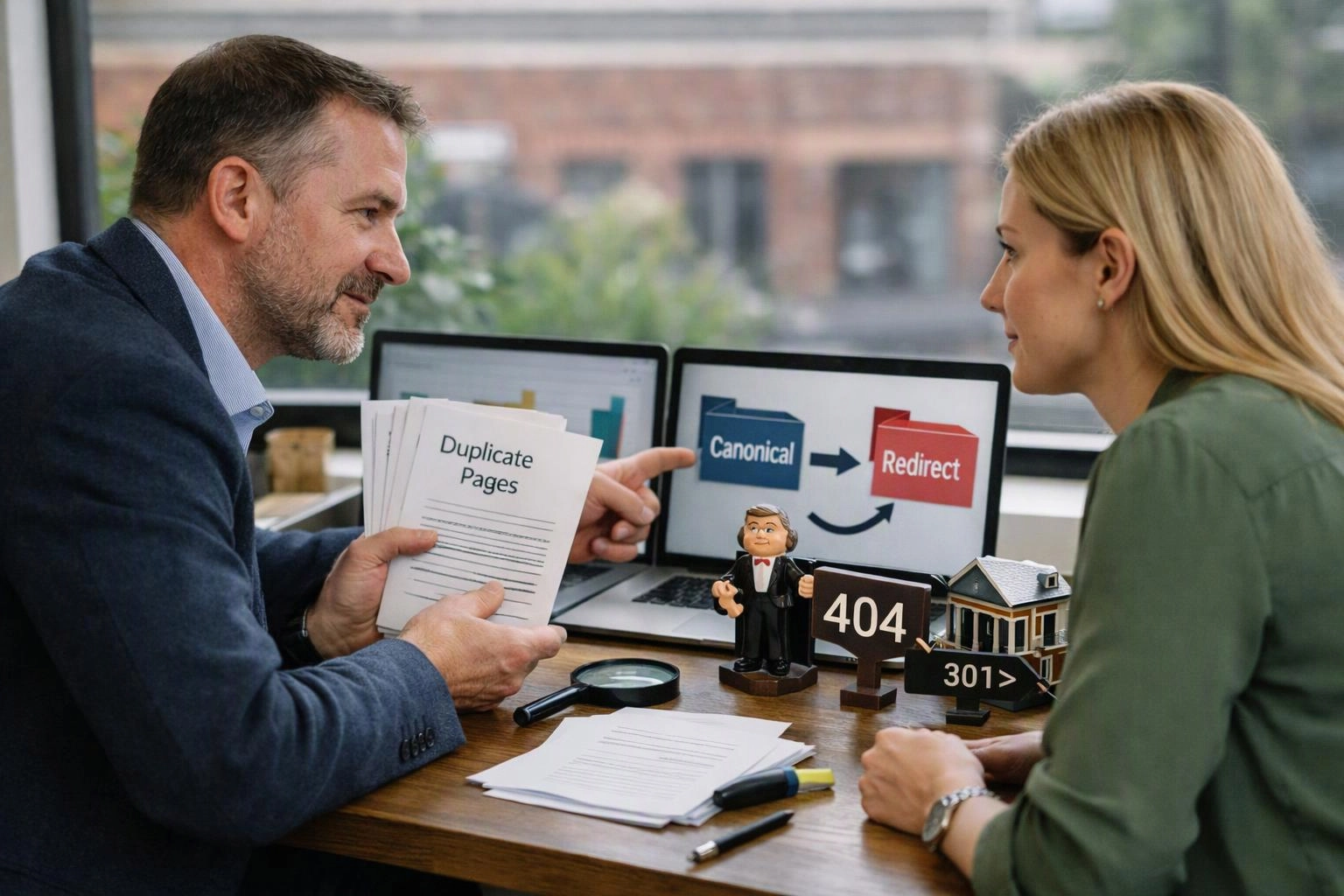
Our review uses crawl data alongside the law firm’s search and site-management information. We separate technical findings from changes that could affect important practice area pages.
When Should You Call SEO-for-Lawyers.com.au?
Technical SEO For Law Firms is most useful when URL changes or indexing signals create uncertainty about important legal pages.
Our team can review the issue before changes create wider problems across the site architecture.
What Our Law Firm SEO Audit Covers
Our Law Firm SEO Audits review duplicate URL patterns, canonical implementation, redirect paths and internal linking so law firms can prioritise technically sound corrections; Free Estimates Available.
We assess how each issue affects crawling, indexing, organic visibility and the route from a search result to a relevant legal service page. The review can include a crawl report, canonical recommendations, redirect mapping and internal link findings.
Where a broader technical review is suitable, we connect these findings with related issues such as mobile page experience and site structure. Our team keeps the recommendations practical so the firm can address the highest-impact URL problems first.
Law Firm SEO Audits can be scoped around the website’s current structure and the pages that matter most to potential clients.
How to Request a Technical SEO Review
Technical SEO For Law Firms can be scoped around the law firm’s website structure, duplicate URL patterns, canonical issues and redirect requirements.
Send our team a website audit brief that identifies recent migrations, practice area changes, indexing concerns and important URLs. We use that information to define the review, the technical checks and the recommendations included in the quote scope.
Our estimate explains the work included and uses upfront pricing. Contact us through our enquiry page to request a review.
Questions About Duplicate Pages, Canonicals and Redirects
Should every law firm page have a canonical tag?
Yes, a law firm page should usually have a canonical tag that identifies its preferred URL, provided the tag matches the page’s content and indexing purpose.
Can redirects replace canonical tags on a law firm website?
No, redirects and canonical tags serve different purposes. A redirect moves users and crawlers to another URL, while a canonical tag signals which similar page should be treated as preferred.
How can I identify duplicate URLs in Google Search Console?
Google Search Console can help identify duplicate URLs through indexing reports, excluded pages and canonical selections. We compare those findings with crawl data, internal links and XML sitemap entries to confirm the underlying URL pattern.
What should happen to an old law firm practice area page?
An old law firm practice area page should redirect to a closely related replacement when that replacement serves the same search intent. If no relevant replacement exists, the page may need an appropriate 404 or 410 response.